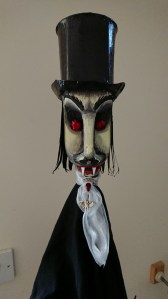
Here is the continuation of the making process of my vampire rod puppet. This is following on from my previous post. I am using the Beverley Puppet Festival making video by Merlin Puppet Theatre as my starting point but I have made one or two small changes. As you will see the puppet is finished and I’m going to have a go at making a little video which I will put in my next post.
Puppet videos are not something I’m used to as I am generally a live performer, so it will be interesting to see what I can come up with. Having had a little play, I have found so far that the length of the kebab skewers for the hand rods are a little short if you want to keep the puppeteer hidden. Just for extra atmosphere we have had a thunder storm today – which (of course) finished just before I started filming!
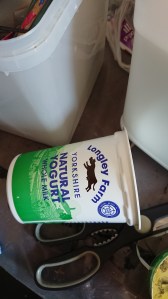
Yoghurt pot for making fangs – the leftover pieces from the hat got recycled so I’m using a different one.
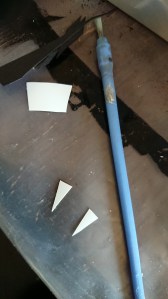
Fangs cut out.
Fangs attached with glue gun.
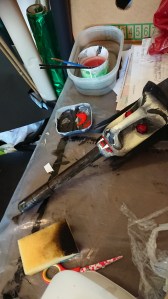
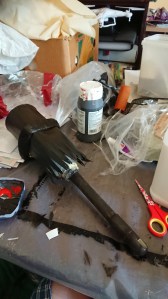
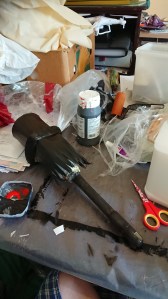
Painting head control black after giving it a little sanding down. I used a sponge this time.
Painting the other side
I use 2 coats for both sides.
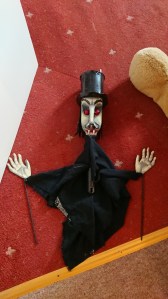
Attaching fabric to neck and hands
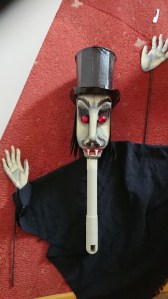
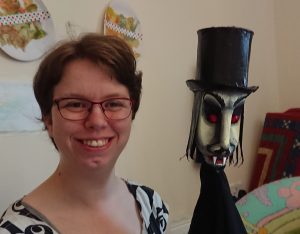
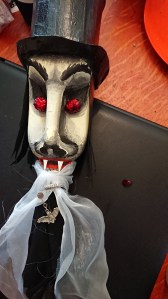
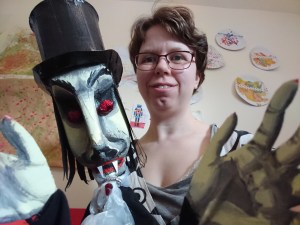
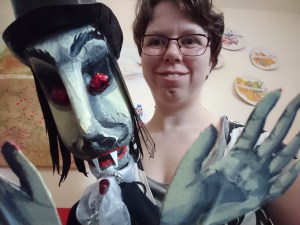
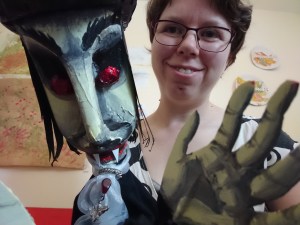
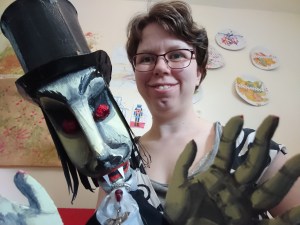
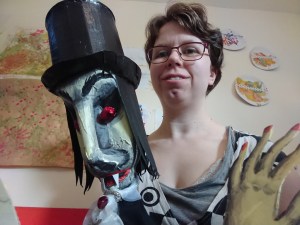
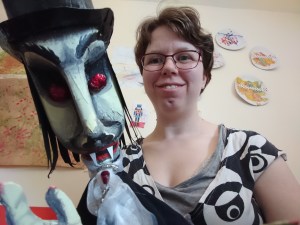
The puppet is complete
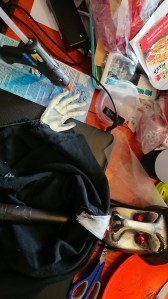
I assemble various scraps that could be useful for embellishments.
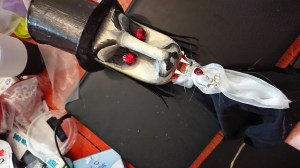
I choose a scrap of (what I think is) polyester organza to make a cravat/scarf plus 2 old clip on earrings and a red plastic tear drop shaped bead.
I find a shape I’m happy with for the fabric and glue gun it in place.
The earrings and bead are also secured with the glue gun glue.
I trim off all the loose threads with my recently acquired hair dressing scissors!
I have been following the Beverley Puppet Festival puppet making workshop videos with great interest and thought that the Vampire Rod Puppet by Merlin Puppet Theatre looked like a quick and easy way to make a version of a type of puppet I already use and make.
I usually use the paper strip and PVA glue method over a plasticine modelled head for puppet heads we use for Rough Magic Theatre shows. For puppet making workshops with Primary Schools, when there is not much time, I have used a dry glue stick and tissue paper over the top of a plastic milk bottle head. This method from Merlin Puppet Theatre seemed like a halfway house between the two techniques (masking tape over the top of a plastic bottle and sanded down). Although it is quick I found it did not produce as smooth a finish as I had hoped it might. However the fact that my bottle shape was not as smooth and simple as the one they used may have had something to do with it. I also like the very simple hand and hand control making technique. I’m looking forward to seeing how well it moves when I’ve finished it.
A 2 pint milk bottle with a handle seemed the best size and shape for head and hat together as I did not have a round soap bottle, though I could have made a yoghurt pot hat like they did.
I used the top of the yoghurt pot to change the square shape of the bottle to a round shape.
The top of the hat is made with masking tape.
I start to cover the face and hat area with tape.
I decided to fill in the hole created by the bottle handle to form the nose shape.
I form the hat brim from masking tape.
I trimmed the hat brim with scissors and sanded the surface of the masking tape down.
I start to paint the face and hat. I will have to try and be neat with the joining edge as theses were formed of two separate pieces in the original. I used acrylic paint.
I do not need to add a cardboard nose – instead I paint shading and detail to accentuate or disguise the shape that is already there.
The bottle already suggests eyebrow and eye sockets so I work with what is already there.
I will add a 3-D ball shaped eye to the socket after as this gives a better 3-D effect than a flat painted eye shape.
I made the hands as suggested in the video and painted the kebab sticks black so they are less obvious.
Gold foil wrappers covered with red cellophane make a glowing/sparkly red eye which is suitably sinister.
I used strong multipurpose glue for these. I also gave the ball shape a flat slanting top to echo the eyebrow shape giving a sinister frowny look.
I add black card hair and turn head upside-down to dry. I used PVA for this.
I found an old aluminium sweeping brush handle which was a good diameter for the head rod.
I measured it against the head and cut it to size with a hack saw. I used the plastic handle end to cover the rough cut end.
I stuffed some old foam rubber pieces, left over from other puppet projects, into the top of the top hat (through the bottle neck) to secure the end of the rod.
I stuffed more foam rubber in round the inside of the bottle neck to secure the other end of the rod. I used some strong multipurpose glue as well.
While the glue was drying I painted some shadows onto the hands to make them look more 3-D.
Next I covered the join between the bottle neck and rod with masking tape and sanded it with the sand paper in the same way as the rest of the head.
I then painted in a mouth.
I painted the chin and neck to match the rest of the head.
I will add the teeth when the paint is dry.
I added some red to the finger nails which I blotted off with paper as it seemed too bright.
I coated the hat with PVA to give a shiny finish and painted some streaks on the hair to better simulate strands and locks of hair.
I also add some PVA “hair” strands to the eyebrows.
It is obviously not finished yet, I will post more pictures of the rest of the puppet making process next week. In the meanwhile congratulations to Beverley Puppet Festival, Arts Council England and all of the artists involved for making such a success of converting the festival to an online format. I am looking forward to trying out some of the techniques from the other videos when I have time too 🙂




 Puppet Lady