Final Filming of Hansel & Gretel Finished at Last!

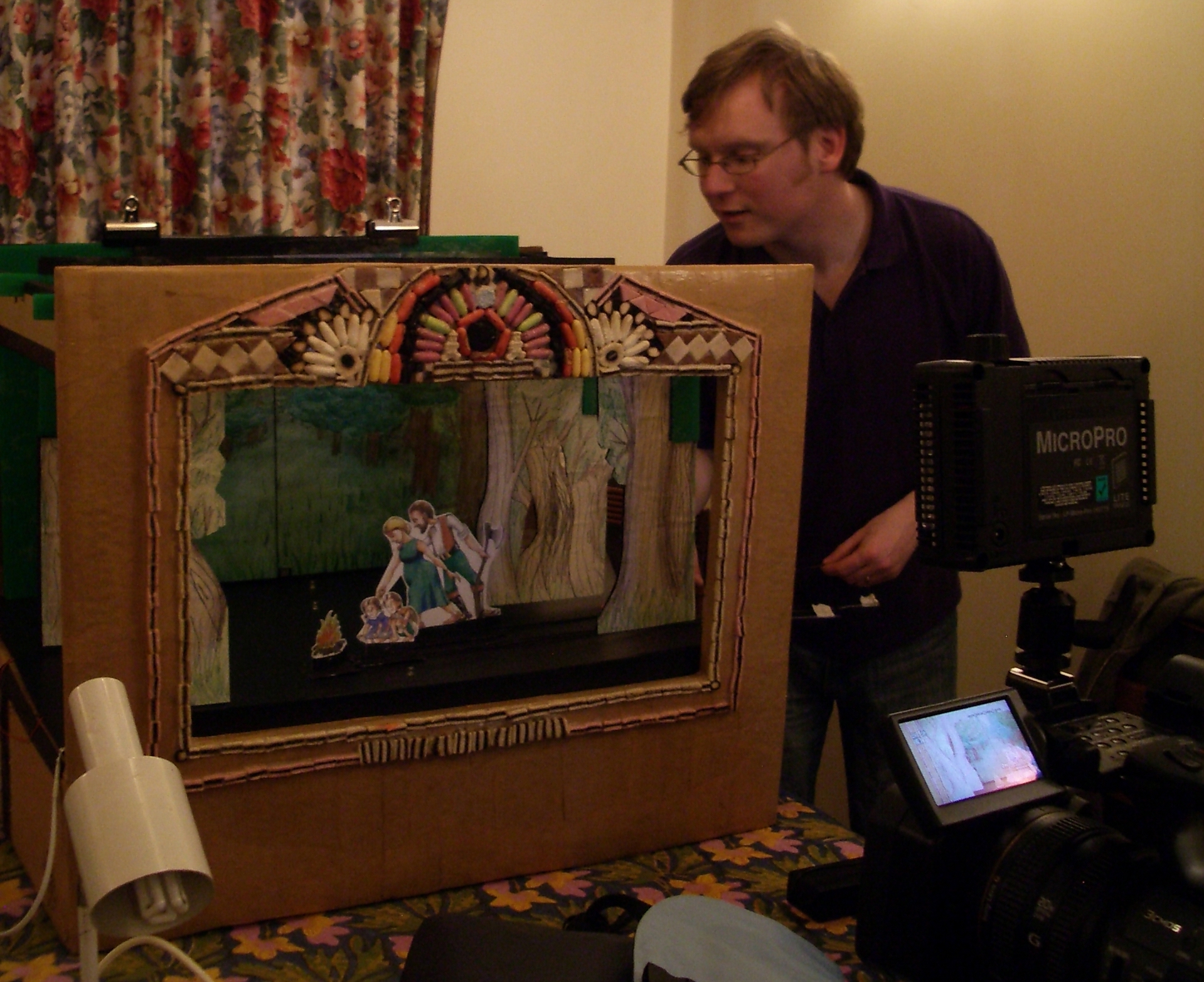
Due to various other commitments the filming of our Toy Theatre show Hansel & Gretel has been dragging on over quite an extended period of time.

Indeed, this time last year we would have been creating it ready for performance at the Vischmarkt Papierentheater Festival in the Harderwijk, The Netherlands.

There were various technical issues that we encountered in the process of doing the filming that made it quite a lengthy process.

Any of you toy theatre practitioners out there who use LED strip lighting for their shows like we do will know that it can cause the recorded images to flicker and strobe.

The flickering rate of the lights is what allows you to dim and raise the light level.  A low light level is created by a slower flickering rate, which is undetectable to the naked eye and all looks great during a live performance.  In addition, levels of light which are fine for a live audience could often “white out” the colour and detail on figures and scenery, so everything had to be adjusted to appear correct for the filmed version.

Getting the show filmed at all was a real treat for my co-performer and husband Tim and myself, because we had never seen the show from the audience’s point of view before.  It was quite hard from a directing and performing point of view to know what to do and where to position the puppets (I call them toy theatre puppets, other people don’t but that’s their business) on the stage.

When I designed the show I worked up a storyboard, like a cartoon strip, for every scene. This included descriptions of the action, vaguely what characters would say and what sound and lighting effects and music should be where.  Then from that I made a separate breakdown of all of the puppets and scenery that would need making and vaguely what they would look like.  After that Tim wrote the script and I did a rough mock up of all of the puppets and scenery and performed the play in a smaller Toy Theatre.  Then going on to make up the best quality full size scenery and puppets.

So from the beginning, I had a visual idea of how I wanted it to look, but the filming was my first real opportunity to see what it was really like.  I’m glad to say that I am pretty happy with it and the dynamic, exciting script and (if I say so myself) the excellent voice performances project real power and emotion into the real issues that affect Hansel & Gretel, their parents and ourselves today.

What Parents at the moment aren’t worried about how they are going to put bread on the table to support their family?  Who isn’t affected by the gap between the super rich greedy people, (like the witch) and the poor, (Hansel & Gretel’s family)?

But, don’t get the idea that the show is all serious and doom and gloom.  It has funny bits, scary bits and of course, (the bit that everyone loves) the nasty greedy witch gets pushed in the oven and the brave, good children triumph at the end.

To those that say that a story like this is unrealistic wish fulfilment and in the real world bad people go unpunished and prosper in their lives, I say it is a story to aspire to and teaches real values.  Little people, like Hansel & Gretel can make a difference if they try hard and support each other in adversity.  Good people who do nothing allow evil to triumph.

But that’s enough moralising; I was telling you about the filming!

In the end we had to use alternative lighting to what we use in the live show, to eliminate the scenes with the worst strobing.  We used the LED lighting rig where possible and as a result there is a tiny bit of flickering on some of the scenes, but we think it is not so bad as to be a problem.

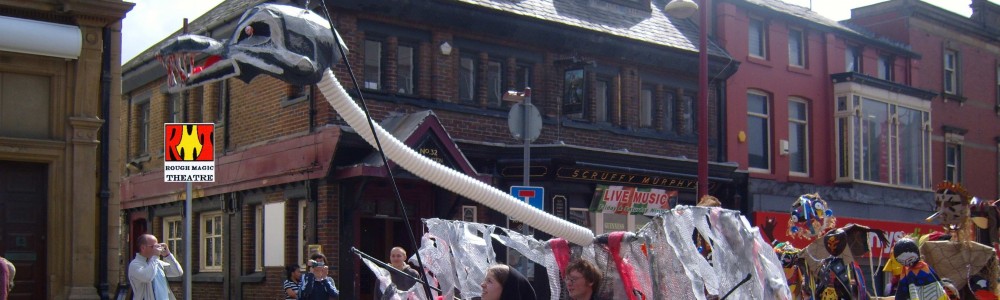
I’m afraid to say the video will not be ready for a little while yet, as there is still a lot of editing to do and we have lots of other commitments to deal with.  We are working on the automaton horse for the “My Last Carnival” celebration to accompany the visit of “My Last Car” to High Bentham.  We will be working on that tomorrow and I will have more news of how it is going, later in the week.  Tim is coming to dread the phrase, “I’ve had another idea…”.

Also, I have been booked to do not one, but two of my Shadow Puppet Suitcase Shows, (“Jabberwocky!” and “Edward Lear’s Nonsense”) at Beverley Puppet Festival on Sunday the 15th of July.  Please look at the “Where to See Me” page for up to date details of all forthcoming performances and workshops.

Indigo Moon – Puppetry Masterclass

Yesterday I visited Zion Arts Centre in Manchester to participate in a Masterclass on shadow theatre by Indigo Moon.

You will notice that I say Shadow “Theatre” rather than shadow puppetry.  Although puppets did form part of what we looked at, it was by no means limited to just that.

I consider myself a gifted and knowledgeable shadow puppet maker and performer, and was unsure whether I would learn a lot.  However, the knowledge that I have of shadow puppets is largely out of books or through personal trial and error.  In addition, we at Rough Magic Theatre are generally masters of the lo-tech tech.  This tech is no less magical for being simple, but simple it is.

Indigo Moon are a wonderful two person team.  Haviel does all the music and technical stuff with the lighting, and Anna does the puppetry and performance.

I think one of the most useful things for me was the different techniques they produced using halogen lamps, though Anna was keen to stress that the things we were shown could be done without the use of halogen lamps.  For example, removing the reflectors from a torch could produce similar effects.  Haviel was also keen to advocate the use of angle poise lamps which are useful for moving about or being fixed in a particular position.

They used an extra bright lamp to avoid their effects being spoilt in school halls without total blackout. However, they also stressed the fact that they had a super-duper rather expensive screen which was designed to stop the light source shining in the eyes of the audience and could be projected onto from either side.  So while they were keen to say the things we were shown could be done using simpler equipment, I am far from sure that every technique we were shown would work as well in all circumstances.

I do feel that one of the joys of shadow theatre is that it can be created by anyone and that you do not need to have expensive equipment.  All you need is a light source, an object to cast the shadow, and a screen of some sort to cast the shadow onto.  You do of course need an audience to look at the shadows, but that goes without saying.  Anna was keen to make this clear as well and the different techniques we looked at were all looking at the variations you could make to each of these elements to create interesting and special effects.

We looked at coloured gels to produce coloured shadows, multiple light sources to create multiple shadows of each object.  This is particularly interesting if the light sources are at different angles.  We were shown a couple of “magic” tricks to morph one person into another person and to join up the top and bottom halves of two different people.  This was done by using two angled lights and sneaky use of “barn doors” to mask off different areas of light.

We were also shown a clever technique which made two 3-D still figures appear to move and dance with each other, by moving the light rather than the people.  This finally solved for me a conundrum that I had been wrestling with about a particular shadow puppetry technique using a 3-D object that I saw a long time ago in “The Girl Who Cut Flowers” by Horse + Bamboo.  I had been assuming that they had been moving a 3-D object in front of light source, but I suspect they were actually inserting the light inside the object.  The effect for the audience is quite magical and also totally bewildering.  This is because the shadow that you see creates an effect totally at odds with what is happening behind the screen.  When doing conventional shadow puppetry, for the most part, the shadow that the audience sees, largely resembles the puppet that is being manipulated on the other side.

Then, you can do things with the screen to change the shadows.  We used pieces of white card to “catch” images from a projector, experimented with rumpled, rippling and 3-D screens, creating almost a tent out of a large silk screen and crawling inside it with puppets, multiple light sources, coloured lights and body shadows too.  In other words, we were a whole load of grown people having a play session.  Anyone who laughs at this idea needs to get more in touch with their creative side, as playing is one of the best ways of developing new ideas.  The majority of great inventions start with a happy accident.

Funnily enough, we did not talk much about puppet making techniques at all.  This was probably just as well, as if we had, it would probably have been covering old ground for me.  Having said that, I did see some interesting control mechanisms that Anna uses on the puppets in Aladdin.  She has metal welding rods to support the puppet from behind, with nylon fishing line to control various moving parts on each puppet, which she controls with metal rings that she can slip her fingers through.  This means that she can articulate specific parts on each puppet using only one hand.  In order to achieve this level of articulation, however, they have had to reinforce the puppet bodies with thin acrylic sheet as well as laminating the card cut out pieces.

It all made me wish that I had the chance to see the show in action, and indeed, I would recommend people of all ages to get to the Zion Arts Centre tonight and see their Aladdin show.  However, if you were to try, you would find that they have sold out, so try and catch them elsewhere on their run.  Click here to see their full gig list.

Anna also had an admirable collection of traditonal Javanese puppets, which are made from cured hide, rather than cardboard and punched with very intricate cut out detailing.  She also gave us a brief insight into her experiences of Indonesian shadow puppetry.  A lot of this was not new to me, but unlike myself, Anna has had the enviable experience of having lived in Indonesia and experienced the tradition first hand.  A point she made about it, which I thought was very telling, is that because it is a live tradition rather than something that exists only in museums; it is constantly changing and renewing itself.  Also, although the stories are very ancient and involve Hindu mythology and characters.  The “clown” characters in particular are used as a vehicle to talk about up to the minute events in a similar way to “Spitting Image”.  Of course the Dhalang or Puppet Master can get away with saying things that are quite politically dangerous, because it is the puppet who says them, not him.

Tangent time – Who reckons we should bring back Spitting Image?  I think we really need some ugly rubber puppets on prime time TV to say the things that the media is not saying.  The press seems to be either supposedly impartial or decidedly right wing at the moment.  Some amusing sketches to show what evil prats the Tories are would be just what we need right about now.  There is no budget for really good programming on ITV and the BBC are intending to give us more repeats than ever before.  I understand that the BBC trust are doing public surveys to find out what direction we want them to go in, so please everyone go and tell them that you want more innovative new programming, not just safe bets, repeats, reality shows and quizzes.