Is it enough to make a pretty puppet?

Huge amounts of stuff have been happening this week.

Among other things, I have been preparing for my primary school workshop at the Bay Primary in Bridlington.

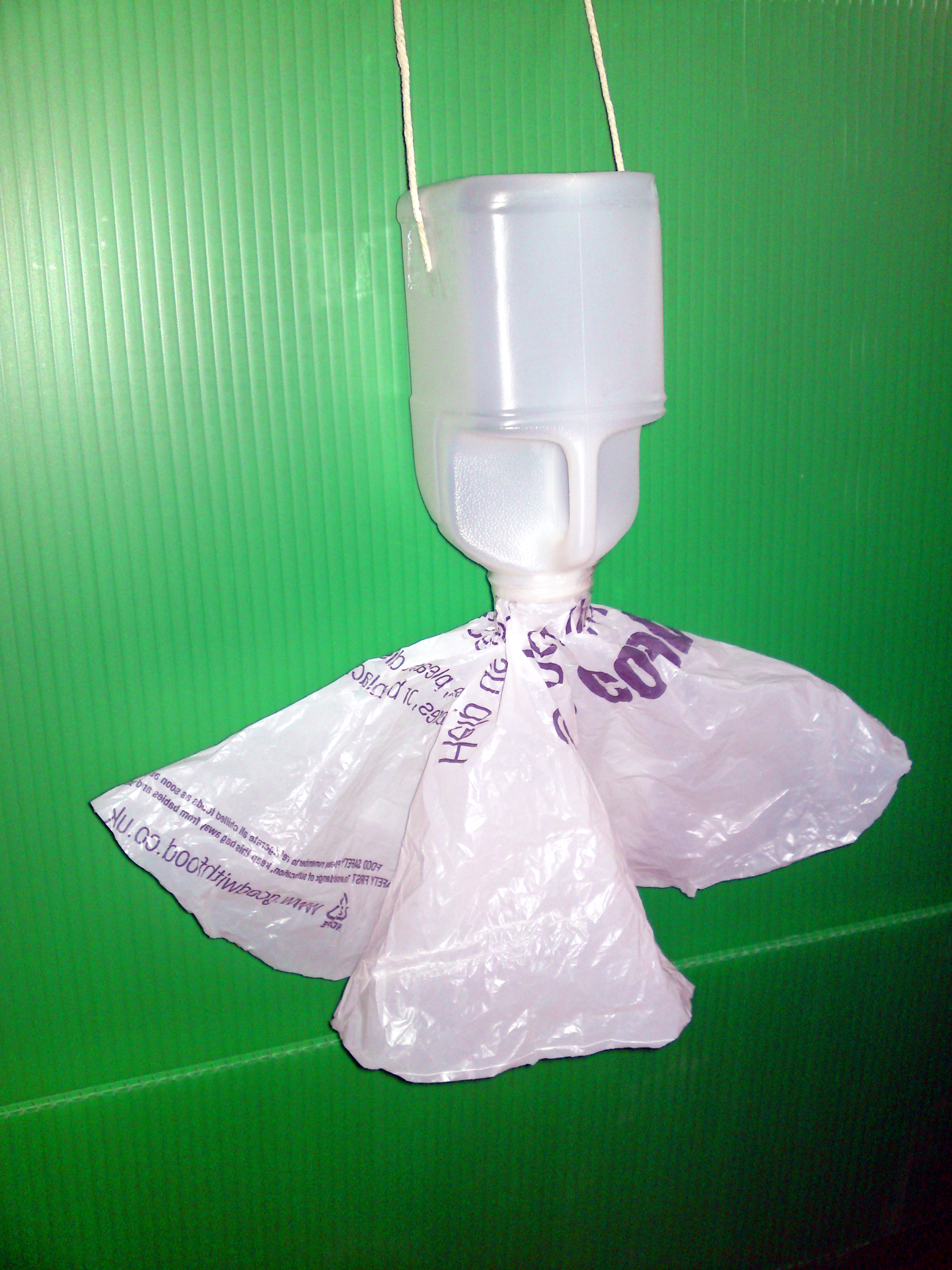
This largely involved cutting circles out of plastic bags, (both good for the environment and cheap for the school).  I have been doing prototypes as well, to check that what the kids will be doing works.
I’ll be working with two classes of Year 1s and they’ll be making a puppet each to the theme of “Lost in the Toy Museum”.  Half will make hand and the other string, but everyone will learn to make both.

In order to make it value for money for the school and to fit as much in as possible, the emphasis is going to be on learning about puppets and how to use them and how they differ from toys, (amongst other things).  The making part will be relatively simple.

I’ve often felt when doing puppet making workshops that while the children have made excellent puppets, that there was no time for them to learn how to use them properly.  It has seemed like it was just a fun activity for them to do with no thought about what happens to the puppet once you’ve made it.

I remember when I was a Brownie, our well meaning Brownie leaders thought that drawing a face on a paper bag, (for a hand puppet) was a good activity for us to do.  But I don’t think a single thought was given to whether or how we would use these puppets to act a story.  I doubt any of them was used to perform with at all.

The point of a puppet is to perform and make theatre.  If a puppet does not get used in this way, it is just a toy, or even a sad useless decoration that hangs on the wall.  I don’t have a problem with decorations or toys but I do not think a puppet is ever truly a puppet unless it is used to put on a show of some kind.

One of the major differences between a puppet and an actor is that an actor will always be themself.  They may be themself dressed differently and acting a character, but they are “acting” and they go back to being themselves afterwards.

A puppet IS the character, it doesn’t take off it’s wig and make-up after the show and then go off for a cup of tea.  It does not have any purpose or life outside of the show.  This may seem sad, but actually it means that puppets are better at totally being the character than a human actor.  They can do things that are physically impossible for a human to do.  They can look like humans cannot too, even with the very best costume or make-up.  Imagine a person trying to do what a dissecting skeleton marionette does.  However thin, a person could never “be” a skeleton that moves, they could just try to look like one.

For this reason, although it is nice to give children complete imaginative free rein, I shall be teaching them to think about what the character of the puppet will be before they fully create its appearance.  In my experience, children left to themselves will often be extremely dull and unimaginative and all copy each others ideas.  If you narrow the options available this can actually increase the creativity of the result.

Consider, who would use their imagination to create a puppet out of rubbish if other “nice” materials are available?  Being creatively selective is what puppet making is all about.  Out of all these things, what looks like an eye?  Narrow it down further; I’ve decided to make an evil character, so I won’t pick something that looks like a cute or friendly eye, but something that could look angry, sinister or supernatural.  Then you have to consider how you want the puppet to move.  If you want a character to move with sharp spiky movements, you might not use a light floaty costume.

So, you can see how, if you wish to make a puppet for performance, you have to think first, then make, then perform.  If you just make and perform, the puppet might not be able to do all the things your story requires.  Just making is a fun educational exercise, but what is it teaching them to do?  To make something that is largely useless and will be quickly abandoned and forgotten.  To make a puppet for performance and to perform a show will be giving a child confidence and pride in their achievements and often brings shy children out of themselves, as it is not them, but the puppet who speaks.  And of course to perform is a puppet’s function, a puppet performing fulfils its reason to be.  Why bother otherwise?
Indigo Moon – Puppetry Masterclass

Yesterday I visited Zion Arts Centre in Manchester to participate in a Masterclass on shadow theatre by Indigo Moon.

You will notice that I say Shadow “Theatre” rather than shadow puppetry.  Although puppets did form part of what we looked at, it was by no means limited to just that.

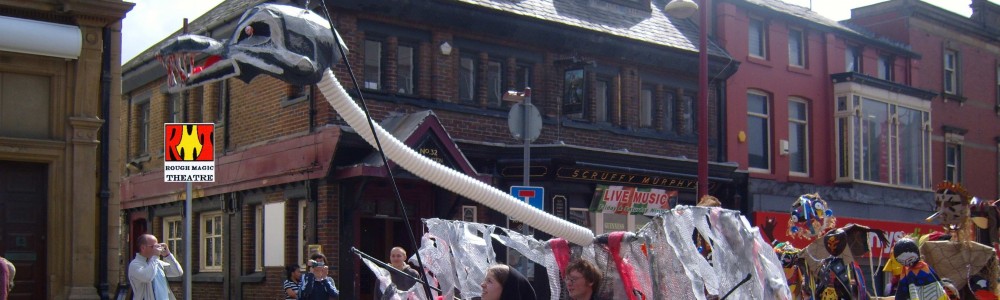
I consider myself a gifted and knowledgeable shadow puppet maker and performer, and was unsure whether I would learn a lot.  However, the knowledge that I have of shadow puppets is largely out of books or through personal trial and error.  In addition, we at Rough Magic Theatre are generally masters of the lo-tech tech.  This tech is no less magical for being simple, but simple it is.

Indigo Moon are a wonderful two person team.  Haviel does all the music and technical stuff with the lighting, and Anna does the puppetry and performance.

I think one of the most useful things for me was the different techniques they produced using halogen lamps, though Anna was keen to stress that the things we were shown could be done without the use of halogen lamps.  For example, removing the reflectors from a torch could produce similar effects.  Haviel was also keen to advocate the use of angle poise lamps which are useful for moving about or being fixed in a particular position.

They used an extra bright lamp to avoid their effects being spoilt in school halls without total blackout. However, they also stressed the fact that they had a super-duper rather expensive screen which was designed to stop the light source shining in the eyes of the audience and could be projected onto from either side.  So while they were keen to say the things we were shown could be done using simpler equipment, I am far from sure that every technique we were shown would work as well in all circumstances.

I do feel that one of the joys of shadow theatre is that it can be created by anyone and that you do not need to have expensive equipment.  All you need is a light source, an object to cast the shadow, and a screen of some sort to cast the shadow onto.  You do of course need an audience to look at the shadows, but that goes without saying.  Anna was keen to make this clear as well and the different techniques we looked at were all looking at the variations you could make to each of these elements to create interesting and special effects.

We looked at coloured gels to produce coloured shadows, multiple light sources to create multiple shadows of each object.  This is particularly interesting if the light sources are at different angles.  We were shown a couple of “magic” tricks to morph one person into another person and to join up the top and bottom halves of two different people.  This was done by using two angled lights and sneaky use of “barn doors” to mask off different areas of light.

We were also shown a clever technique which made two 3-D still figures appear to move and dance with each other, by moving the light rather than the people.  This finally solved for me a conundrum that I had been wrestling with about a particular shadow puppetry technique using a 3-D object that I saw a long time ago in “The Girl Who Cut Flowers” by Horse + Bamboo.  I had been assuming that they had been moving a 3-D object in front of light source, but I suspect they were actually inserting the light inside the object.  The effect for the audience is quite magical and also totally bewildering.  This is because the shadow that you see creates an effect totally at odds with what is happening behind the screen.  When doing conventional shadow puppetry, for the most part, the shadow that the audience sees, largely resembles the puppet that is being manipulated on the other side.

Then, you can do things with the screen to change the shadows.  We used pieces of white card to “catch” images from a projector, experimented with rumpled, rippling and 3-D screens, creating almost a tent out of a large silk screen and crawling inside it with puppets, multiple light sources, coloured lights and body shadows too.  In other words, we were a whole load of grown people having a play session.  Anyone who laughs at this idea needs to get more in touch with their creative side, as playing is one of the best ways of developing new ideas.  The majority of great inventions start with a happy accident.

Funnily enough, we did not talk much about puppet making techniques at all.  This was probably just as well, as if we had, it would probably have been covering old ground for me.  Having said that, I did see some interesting control mechanisms that Anna uses on the puppets in Aladdin.  She has metal welding rods to support the puppet from behind, with nylon fishing line to control various moving parts on each puppet, which she controls with metal rings that she can slip her fingers through.  This means that she can articulate specific parts on each puppet using only one hand.  In order to achieve this level of articulation, however, they have had to reinforce the puppet bodies with thin acrylic sheet as well as laminating the card cut out pieces.

It all made me wish that I had the chance to see the show in action, and indeed, I would recommend people of all ages to get to the Zion Arts Centre tonight and see their Aladdin show.  However, if you were to try, you would find that they have sold out, so try and catch them elsewhere on their run.  Click here to see their full gig list.

Anna also had an admirable collection of traditonal Javanese puppets, which are made from cured hide, rather than cardboard and punched with very intricate cut out detailing.  She also gave us a brief insight into her experiences of Indonesian shadow puppetry.  A lot of this was not new to me, but unlike myself, Anna has had the enviable experience of having lived in Indonesia and experienced the tradition first hand.  A point she made about it, which I thought was very telling, is that because it is a live tradition rather than something that exists only in museums; it is constantly changing and renewing itself.  Also, although the stories are very ancient and involve Hindu mythology and characters.  The “clown” characters in particular are used as a vehicle to talk about up to the minute events in a similar way to “Spitting Image”.  Of course the Dhalang or Puppet Master can get away with saying things that are quite politically dangerous, because it is the puppet who says them, not him.

Tangent time – Who reckons we should bring back Spitting Image?  I think we really need some ugly rubber puppets on prime time TV to say the things that the media is not saying.  The press seems to be either supposedly impartial or decidedly right wing at the moment.  Some amusing sketches to show what evil prats the Tories are would be just what we need right about now.  There is no budget for really good programming on ITV and the BBC are intending to give us more repeats than ever before.  I understand that the BBC trust are doing public surveys to find out what direction we want them to go in, so please everyone go and tell them that you want more innovative new programming, not just safe bets, repeats, reality shows and quizzes.