In February this year I was preparing the kids for their first public performance in our local community pantomime (Bentham Theatre Group).
Last year’s pantomime was “Peter Pan” and Anthony and Miranda were then aged nearly 3 and 5 years old. They (and us) attended all of the rehearsals including the dress only for Tim and I to test positive for Covid just days before the performances.
Obviously, we all had to isolate as a family and the kids didn’t get to perform in the show.
I was determined that this year would be different and we went through the whole process again. This year’s Panto being “The Wizard of Oz”. The kids initially said they wanted to be in it but then were a little daunted when I first played the MGM film for them and found it quite frightening. Soon after, however, I was getting repeated requests to play the film from Miranda and Anthony enjoyed it too. Anthony tends to be wary of films when he doesn’t know what will happen but enjoys them on repeated viewings.
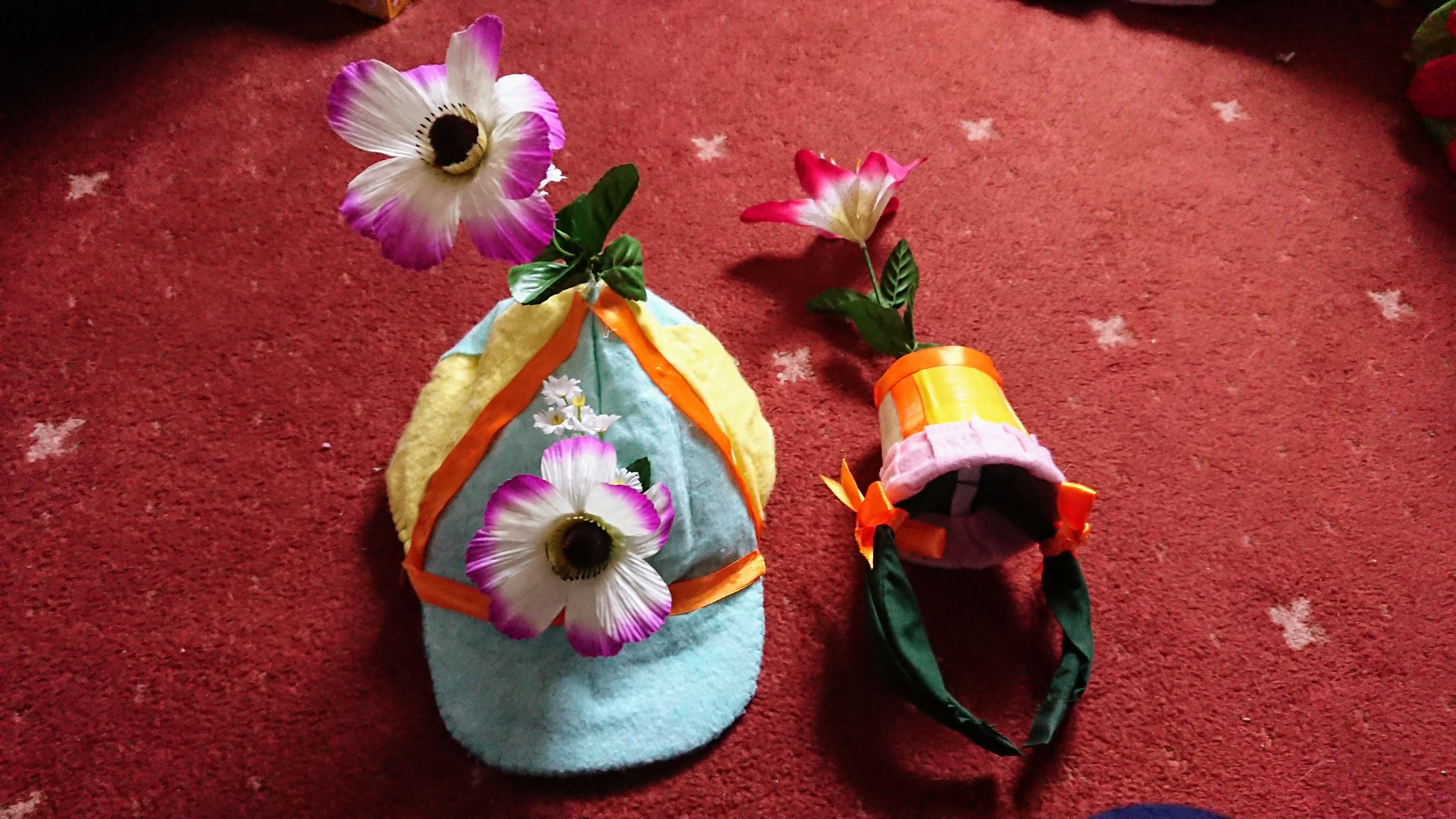
I told them that they could be Munchkins or Flying Monkeys and they were keen on the idea of being Munchkins so I had to make them some Munchkin hats (see below) which I was quite proud of. They are made of various things I had lying around the house:
I built them onto a hat and a headband that we already had as I was concerned that a thin elastic would bite into their necks and be uncomfortable and I wanted them to be able to be able to wear them for extended periods without taking them off all the time or refusing to wear them.
I had a dentist’s appointment in the week of the panto performances and having got a cold I thought I had better take a lateral flow test to double check it wasn’t Covid. Unfortunately the test was positive and not just a faint line but a vibrant dark red that appeared almost immediately.
I took myself off to the top of the house (where our bedroom is) and Tim tested himself and the kids and their tests were negative.
Tim and I were both determined that the kids wouldn’t miss out on their Panto performances 2 years running, so Tim looked after the kids, took them to the performances and provided me with food and drinks at intervals, (he was a proper hero and slept on our very tiny sofa as well). We were very careful (using copious amounts of sanitising spray and wipes) and the kids managed to do their Panto performances and thoroughly enjoyed themselves.
Meanwhile, I was stuck in my bedroom upstairs not having to look after the kids and able to watch copious amounts of T.V. on my laptop. So, not all bad.
I started to feel pretty yucky and got lots of sleep in soon after I went upstairs, but when I wasn’t sleeping and eating I watched some Anime films on Youtube, (I found a Studio Ghibli film I hadn’t seen before called “Angel’s Egg” which was VERY interesting). I really wanted to re-watch Howl’s Moving Castle again but discovered the only place I could get it was Netflix so I caved in and got myself a cheapo subscription.
Having binge watched a large number of Studio Ghibli films I suddenly remembered that Guillermo del Toro’s Pinocchio was on Netflix and decided to watch that.
I had already seen numerous trailers bigging up the stop motion on this film, saying that it took the medium to a higher level than ever seen before, using Del Toro’s vast experience in the direction of live action films and transferring camera techniques more usually reserved for live action to the stop motion medium:
I shall do a full review of this film and comparisons with Disney’s recent live-action/CGI re-make and Upfront Puppet Theatre’s live puppetry Pinocchio in my next blog post…..Watch this space…. 👀!
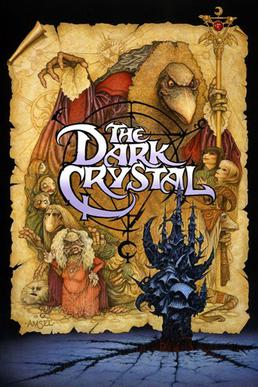
The Dark Crystal (1982) movie was one of the formative puppetry experiences of my youth. As I was born in 1982 I did not get to experience it at the cinema but rather watched it on the television in later years.
Sadly I do not remember exactly how old I was when I first saw it but, at a guess, I would say around 7 years old.
I remember it was frightening, or rather, had frightening bits but I was not distressed by it in the same way I had been by Moley in the Wild Wood (in Wind in the Willows by Cosgrove Hall). I used to make my Mum fast forward that bit on the video when I was 3 or 4 years old.
I think the worst bits were the collapsing face of the old emperor and the draining of the essence of the podling and then Kira, (though she did escape). The little detail of the tiny Podling child with her little doll when the Garthim raid the Podling village is also moving, (but I think adult parent of 2 small children me picked up on that more than child me did). However my main feelings about the film were that it was an exciting magical world. I did not even think of it as puppetry. The characters and the story were real creatures from another world that we just happened to have a window inside. I think I felt the same way about the characters from the Cosgrove Hall Wind in the Willows. As stop motion models/puppets everything was really real and was actually occupying real space rather than being a bunch of pixels in a computer.
I also found the Skeksis amusing rather than scary through much of the film. The disgusting way that they eat is so wonderfully tactile and filled me with the same childish glee that one gets from a Roald Dahl book such as “The Twits” or “George’s Marvellous Medicine”. The Chamberlain and his constant repetitious “whining” “mmmMMMMMmmm” was one of my particular, favourite bits of the film.
Re-watching the film with adult (and puppeteer’s) eyes sadly involves my analytical brain popping into gear. I can see the traditional puppetry style of the Jim Henson company in the way the Podlings and some of the other puppets move (the same style that we see animating Muppets and characters from Sesame Street). I was also a big fan of Sesame street growing up. I was too young for the Muppet Show and again, at the time did not think of the characters as puppets, (they were real).
I can also clearly see the multiple legs of the Garthim masking the real legs of the puppeteers (because I am looking for them) and that the Land-striders are the same shape as a person with stilts on arms and legs (because that’s what they are). What I am not sure about is whether I notice this because I am a puppeteer and puppet maker or because I am now an adult.
The Dark Crystal Age of Resistance has modern technology to help make the world as real as possible for an adult audience (they assume that fans of the original will be watching the prequel and are therefore now adults). In theory (as with the original) it is supposed to be for a family audience, but if so I would say it is definitely more suitable for older children. They have used green screen technology to remove puppeteers from shots and CGI to remove visible puppet rods. They have also used CGI for various special effects, backgrounds and the creatures that are in the place of wheels in the Skeksis’ carriages. From my research I have discovered that Jim Henson was not entirely happy with the puppet Gelfling as major protagonists as they did not have a lot of expression due to the small size of the heads and this is the reason they used human actors in the subsequent Froud/Henson collaboration film “Labyrinth“.
The Gelfling head animatronics in AOR is an improvement on the original heads with movable eyebrows allowing for a range of expressions though the jaw/mouth is rigid and simply opens and closes. The heads have also been augmented with CGI for certain shots (adding in eye blinks etc.).
The Director says that his aim was to make people forget that they are watching puppets and I’d say that the Gelflings and Podlings are the most problematic when it comes to that, (the Podlings are definitely a bit “Muppety” but very fun to watch). On my first watch through of the series (I binge watched it) I definitely found the rigid mouths of the Gelfling puppets a little off putting and found the expressions they were capable of a bit limited at first, but as the story progressed I found I became more absorbed by the story and less conscious of the Gelfling puppets’ limitations. They are undoubtedly beautiful puppets and I found Deet the most engaging of the main, Gelfling, characters. Her colouring (particularly her lustrous amber eyes) is very beautiful and she has a wistful, poignant expression that fits with the character’s eventual tragic ending (I say “ending” as with the series being cancelled we are sadly never going to find out what eventually happens to Deet).
On subsequent re-watchings of the series, I found, (as I often do) that as I already knew what was going to happen in the story, that my brain, (once again) started to focus on how everything was done technically.
I loved the very knowing and amusing reference to the artform of puppetry in the “puppet show within a puppet show” episode. The miniature puppets were wonderful and there was no pretence that these were anything other than puppets telling a story. The Dark Crystal film was criticised by some for not having enough humour in it (hence the change of tack in “Labyrinth”) but this episode of AOR was packed with humour from the very eccentric “Heretic” and “The Wanderer” and the interplay between the two.
I have read that the decline in popularity of the Bunraku theatre in Japan was possibly due to the fact that the puppets were too realistic and that once a puppet reaches a certain level of realism then it prompts the question: Why use puppets at all when an actor can portray so much more expression? The obvious answer to this in relation to the puppet Gelfling is that they are not human, merely human-like. I don’t know how much better a human with make-up/prosthetics would look compared to a realistic puppet, but I suppose the obvious comparison here would be Peter Jackson’s “Lord of the Rings” films. The Hobbits and Elves are wonderfully expressive because they are human actors and of course they pioneered the motion capture suit technology for the character of Gollum, (which one could argue is another form of puppetry).
However, I have seen the screen test footage that “The Jim Henson Company” created using a puppet Skeksis and a CGI Gelfling and even though (in my opinion) the Gelfling was a bit basic CGI wise compared to Gollum, the Skeksis and Gelfling do not match up together in terms of the way real objects catch the light etc. The puppet Skeksis in my opinion would not be better as human actors because they are not human-like and, therefore, they play to the strengths of the puppet; which is to do things that a human actor cannot do and to be things that human actors cannot be. There is no room for improvement with the Skeksis in terms of their appearance or performance in my opinion. They recreated the brilliance of the Skeksis in the original film and gave us more of what we liked in the first place and developed it and took it further, with a little CGI augmentation here and there (tongue movements for example).
The combination of Warwick Brownlow-Pike as puppeteer and Simon Pegg as the voice actor did a fantastic job of bringing the character I loved so much from the original film back to life and recreating and building on that original performance by Frank Oz and Barry Dennen. I would say that Warwick should take the greater credit for the acting performance of The Chamberlain when you consider that the voice-actors were matching their performance to the visual performance that the puppeteers had already created.
So if we agree that the Skeksis need no improvement and that they don’t match visually with CGI Gelfling then we are back to the decision to make the Gelfling puppets with little “pops” of CGI like the AOR did in fact use.
I think the problem is that the quality and realism of everything in the series is so high (with nearly everything physically there and lovingly handcrafted by experts at the top of their game) that very small flaws stick out rather more than they would otherwise do.
This series is, and will remain, an example of a crowning achievement of what is possible with puppetry; breaking new ground and inventing new ways of doing puppetry for TV that have simply never been done before. The puppets have been pushed to the absolute limits of what is possible and the Director, Louis Leterrier, pioneered the use of multiple hand held steady-cams to shoot the puppets which particularly pays off in the epic sequence where Rian is rescued from The Chamberlain’s carriage.
Performers of TV/film puppetry are used to being in complete control of what the camera sees by using monitors to view their performance as they do it. But, obviously with this approach (even with a split screen monitor) the puppeteer is not in quite so much control of the shots and I imagine they would have to approach the performance more like a human actor would. Leterrier directed all of the 10 one hour long episodes (a huge commitment which gives the series a unified overall vision) and he brought his experience of directing action fantasy films such as the 2008 The Incredible Hulk film to the project.
This is such a rich source of material to discuss one could write whole books about it (and indeed many people have). I am aware that I have only covered a fraction of what there is to talk about with both the original film and the Netflix series, (including the contentious issue of the cancellation of the series) but I have to draw a line somewhere.
To those at Netflix who think that the series is too expensive to make versus the amount of new subscribers they gained who wanted to watch this series; I would say that I would recommend anybody to subscribe to Netflix* just to get to watch this show (if you haven’t already seen it). If you haven’t already seen the original 1982 film or want to re-watch it; you can’t get this on Netflix. I downloaded the film via *YouTube Movies but perhaps it is available from other places too? Please mention in the comments section if you know of other places you can get hold of the film.
On a non-puppetry note if you are a similar age to me and remember “She-Ra” and “He-man” from your youth with affection there is an original Netflix series “She-Ra and the Princesses of Power” (which is a Manga style animation). It is aimed at people of our age who remember the series from our youth and the characters/plots/writing are sophisticated with lots of emotional depth. It is, in short, immensely superior to the original which was created solely to sell toys. So if you do decide to subscribe to Netflix I would recommend this as well (I have also enjoyed/am enjoying their series of “A Series of Unfortunate Events” and “Dirk Gently’s Holistic Detective agency”).
I welcome comments and would be particularly interested to hear from anyone who was involved in the making of “The Dark Crystal” or “The Dark Crystal Age of Resistance”. 🙂
*Please note I have not been paid anything by Netflix or Youtube to mention them and am wholly impartial.

 Puppet Lady