A Visit to the Harlequin Puppet Theatre

I wrote the blog post below before all the business with Covid-19 and social distancing kicked off and unfortunately it is not currently possible to visit the Harlequin puppet theatre for a show.  However Chris has been busy and has compiled a series of online puppet videos which you can view by clicking HERE


We have a good friend who lives in Porthmadog, North Wales, who we have visited and stayed with on a number of occasions and each time the route has taken us through Colwyn Bay.  I kept thinking to myself that we should visit the Harlequin Puppet Theatre at some point and then didn’t get round to it.

So when we visited my friend at October half-term time in 2018, we discovered the theatre did have a show on (the theatre has its showings at school holiday times).  So we booked some tickets and took my friend with us as well.

I was surprised that she had not heard of the Harlequin Puppet Theatre before but perhaps it is less well known to non-puppetry enthusiasts.

I had looked up the theatre previously on Trip Advisor and found many glowing reviews from the parents and grandparents of young children and so I had a good idea of what to expect.

The Harlequin is, very much, a one man operation.  Chris Somerville works the box office, acts as usher, M.C., marionette puppeteer and magician as well as selling the interval refreshments.

Indeed, for everything that is included (and compared to other tourist attractions for entertaining families on offer) the whole thing is extremely reasonably priced.

It a small audience when we visited, as the main Welsh school holidays had not started yet.  But as part of the small but select audience, Chris was entertaining some of his fellow puppeteer friends (including Geoff Felix whom I had met previously at various puppetry events such as Skipton Puppet Festival).

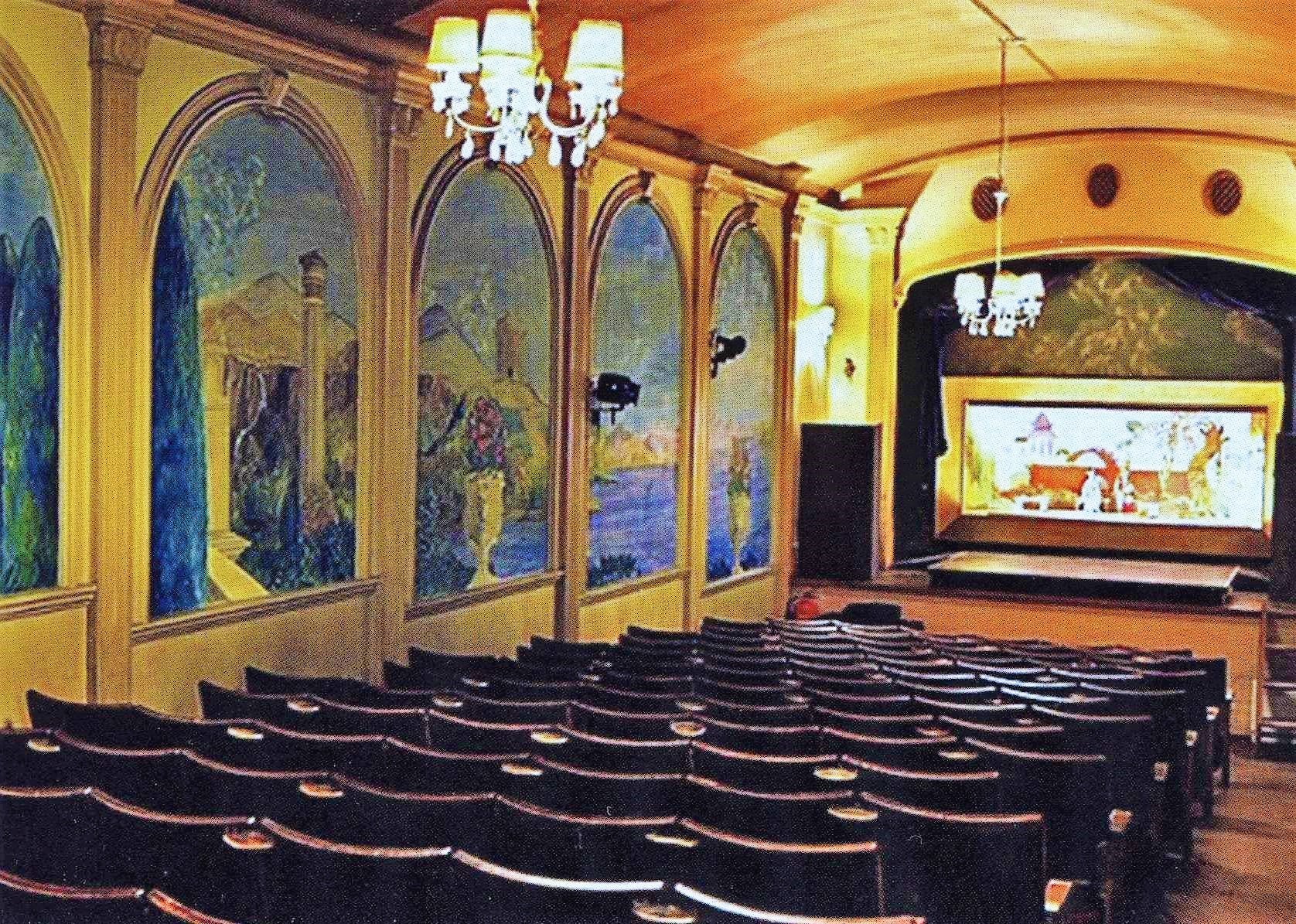
I was pleasantly surprised to see how good the auditorium was looking, given what I had heard about the previous arson attack on the theatre.  You could see that the fire door had been replaced with a modern plain door which I presume is a temporary fix until Chris can afford something more in keeping with the period of the original theatre interior.  It also appeared a small section of the ceiling had been replaced with a temporary fix as well.

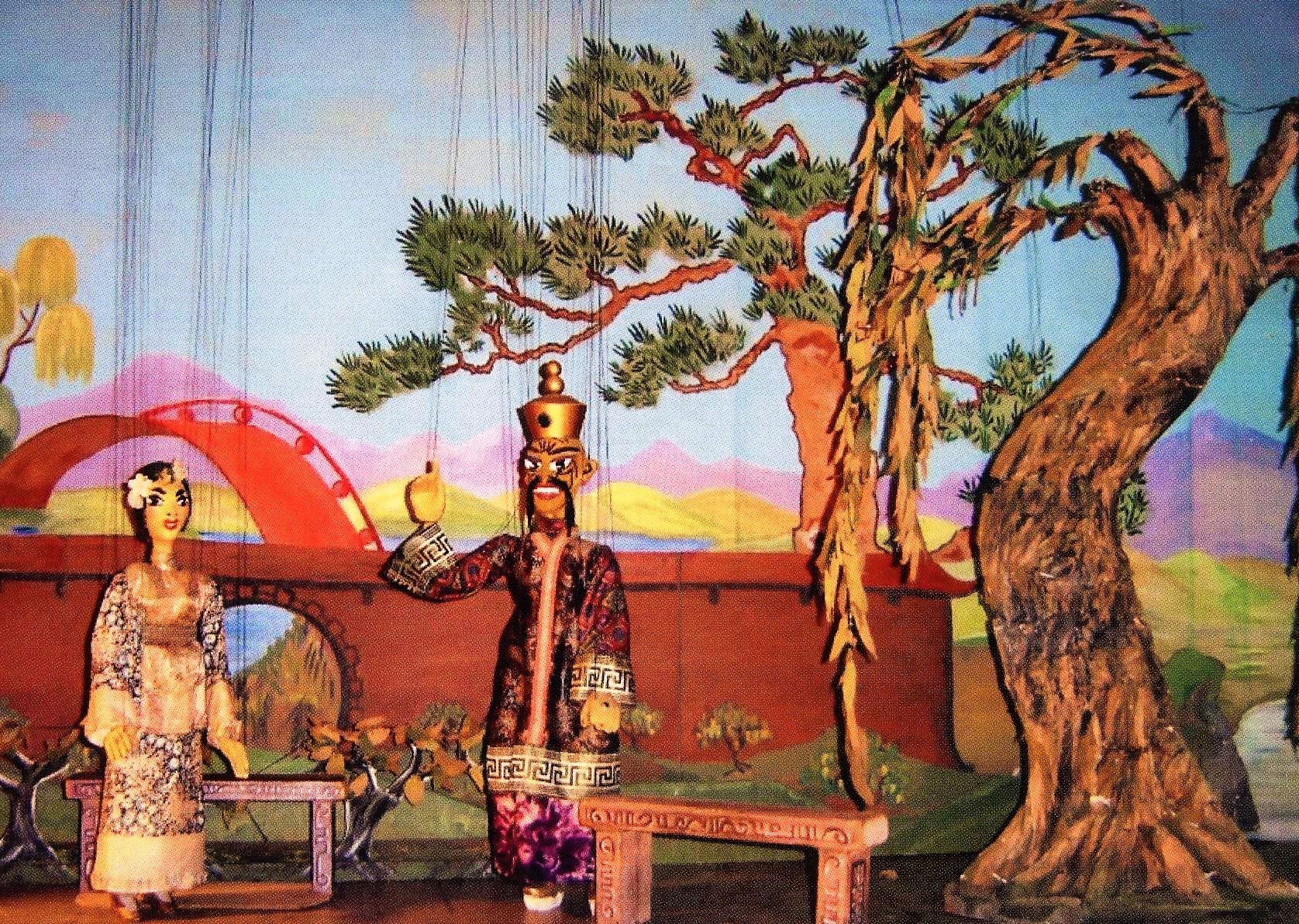
The show consisted of a fairytale “The Gooseberry Mandarin” written originally in 1928 by Grace Dorcas Ruthenburg as a one act play and originally adapted for the puppet stage by Eric Bramall.

It says on the website that Chris has created this as a new production in 1999, but I am guessing it uses the original voice artists, soundtrack and puppets created by Eric Bramall “back in the day” and perhaps Chris adapted the show to be performed with a single puppeteer, (you can see from the video below that in its heyday the Harlequin productions used more than one puppeteer at a time) in 1999.  It had a sense while we were watching it of stepping back in time to a previous era.

Our young son Anthony (who was about 18 months old when we visited) was kept entertained through this simple, charming (and fairly short) story after which there was an interval where we enjoyed some ice-creams.

The next section was Chris as Mr. Bimbamboozle doing magic tricks with the assistance of a young lady from the audience.  Chris is extremely good at interacting with the children and the fact that his repertoire and format does not change means that he is extremely well practiced and experienced at what he does and this shows.  He had great stage patter and all the comedy magic tricks were expertly done.

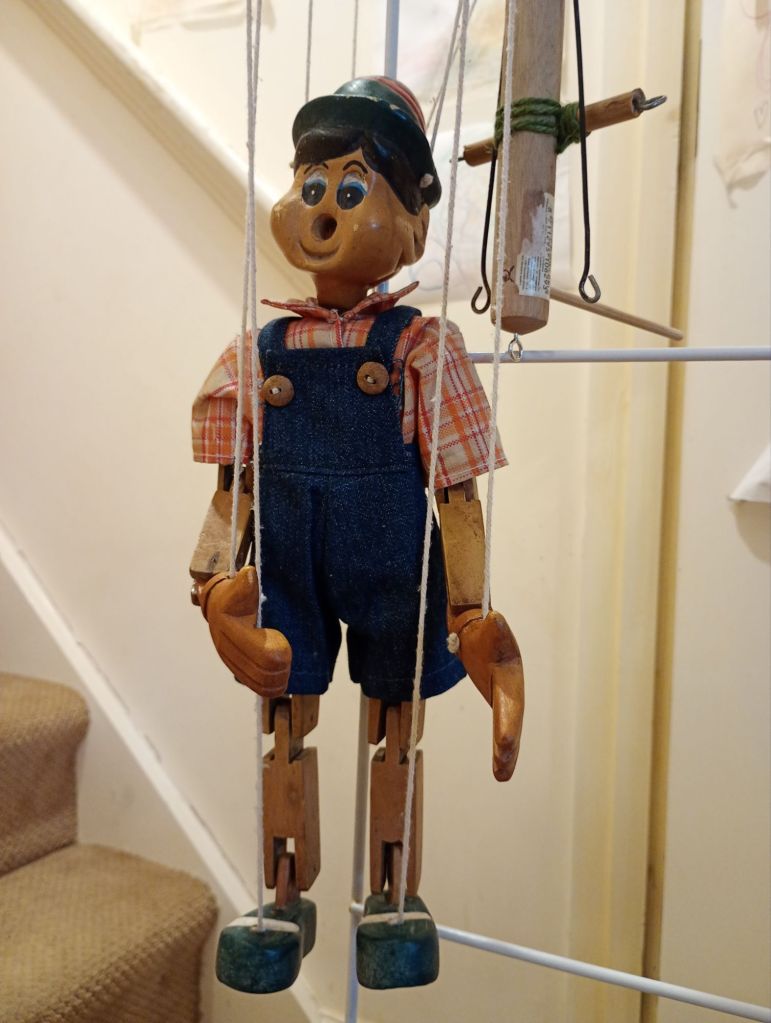
After this came a marionette cabaret using short string marionettes with Chris visible up front operating the puppets.  This is obviously a real treat for the children (and the adults) who may be used to CGI tricks where you cannot see how it is done and is not physically present in the room.  I have found in our shows audiences entranced by very simple techniques in our show “The Tempest“.  On one occasion a man could not understand how the shadow puppets were operated when no-one was inside the booth to do it.  It didn’t occur to him that the puppets were not actually moving at that point!

Again the marionette puppeteering skills were incredibly good.  A Shirley Bassey pastiche puppet was very amusing (“Burly Chassis”) though a little dated perhaps.  On the other hand – a classic performer like Shirley is a good choice for a puppet with a long run as modern performers come and go and the current flavour of the month in pop music does not last as long as a puppet does!

The format of the entertainment, using multiple short performances with an interval as well, plus the extremely good interaction with the audience as Master of Ceremonies meant that our 18 month old son Anthony stayed enthralled in his seat throughout.  Anthony was quiet during the performances and did not seek to escape and walk around the room.  This was great, as we had to take Anthony out when we attended Upfront’s “Pied Piper of Hamelin” with him.  This was no fault of Upfront’s production, it was just designed for an older audience and indeed, Anthony was younger when he saw it.

So to conclude, I would heartily recommend anyone (especially puppetry enthusiasts and families) to visit the Harlequin Puppet Theatre (once he is back up and running) and see a show if you’re in the area to be thoroughly entertained by a master performer!

Click the link to the Wikipedia entry below for more information about the theatre.

Wikipedia entry

Beverley Puppet Festival and Upfront Puppet Theatre’s “The Pied Piper of Hamelin”

We optimistically purchased tickets to see Drew Colby’s “My Shadow & Me” (Shadowgraphy) some time prior to the Beverley Puppet festival and checked whether we would be ok to bring a 1 year old child with us.  We thought that with a showing of 2pm we stood a good chance of being able to get Anthony ready and travel over 100 miles east across Yorkshire in time.

Then we found out that there would be a Puppeteers UK meeting there as well at 10am and I thought to myself if we do REALLY well we might even get there for the meeting too!

We did NOT get there for the meeting too.  We didn’t even get there for 2pm.  We only managed to leave the house by around 10.30am and of course we had to stop for lunch and in the end only just got to the festival in time to see anything at all!

We caught most of the “Tiniest Cellist” act by Ettenoiram (of Hungary).  Clive Chandler’s Punch & Judy was nearly over when arrived so we just had a little chat with him after his show.  We also saw Lady Lucinda Harrington-Carrington by Noisy Oyster (of Frome) heading by (whom we had encountered at Beverley when we performed there previously) and also saw Professor Ambrose Merryweather & His Fabulous Fossils by
Vivify (of Scarborough) in the distance.

We had been thinking disappointingly that in order to be back in reasonable time to put Anthony to bed we would have to set off home again but when Mark Whitaker appeared for a 4pm performance of A Bird in the Hand Theatre’s “Special Delivery”, we thought we couldn’t really pass up an opportunity to actually see a full show.

Ironically, the main two acts I had caught at Skipton Puppet Festival the previous year (when Anthony was a very tiny fellow all wrapped up in his pram from the rain) had been Mark Whitaker’s “Special Delivery” and Clive’s Punch & Judy.  We had unfortunately not been able to watch all of Clive’s show as at that age he had found it too loud and started crying.  Anthony was able to watch and appreciate properly Mark’s show this time and my husband and Rough Magic Theatre co-performer had not seen it before, either.

It is a lovely little street theatre show – very adaptable (somewhat like my shadow puppet suitcase shows) in that the whole staging is mounted on a bicycle which is wheeled into the space by Mark and then remains there, freestanding, (using the kick-stand).  This leaves Mark free to perform around it and use more of the space (coming close up to the audience for various bits of action etc.

The show includes a whole range of different types of puppetry and story-telling techniques including a “crankie” and Kamishibai style “storyboards” and various small “table-top” type puppets.  These show the interior of various people’s houses who are receiving parcels, which are themselves in little puppet theatre boxes designed to look like paper packages on the bicycle.  This is in addition to some lovely wordless slapstick character work by Mark, (in the character of hapless postman) involving sandwiches and self-raining umbrellas (a joke that worked much better in Beverley in the sunshine than in Skipton, where mother nature was already providing plenty of rain!).  Altogether a very charming and magical show (the finale with the hot air balloon is particularly lovely).  It is, however, definitely a show for an intimately sized audience as the puppets are very small scale.


This slideshow requires JavaScript.

As I explained in my previous post, John & Elaine Parkinson of Upfront Puppet Theatre were kind enough to invite us to see their new improved version of their production of the Pied Piper of Hamelin based on the Michael Morpurgo version of the story.

We were not sure how well Anthony would cope with an indoor marionette show of this length but he seemed to stay pretty happy for a good long stretch before needing a bit of a break for a drink.  When we tried him again after the interval he once again seemed to get frustrated that he could not get close and play with the puppets, (making distressed noises when characters disappeared from view).  This unfortunately meant Tim did not get to see all of the show as he took Anthony out when he was getting too noisy.

The Michael Morpurgo version of the story has (as you would probably expect) a bit of a moral and political agenda compared to the traditional tale.  The town of Hamelin has a sharp divide between rich and poor – with the poor street children at the bottom of the heap and kept outside the town walls scavenging on the rubbish tip.  Because of their unwillingness to share with or even encounter the street children (who are forced to steal to survive) the townspeople begin to foul the streets with rubbish to avoid having to take it to the tip.

The rats migrate from the rubbish tip into the town (and so do the children in their search for something to eat).

The Mayor of the town is the villain of the piece being greedy and not using the people’s taxes to benefit the townspeople (by dealing with the rubbish properly for example).  He of course refuses to pay the Piper properly and in this version of the story the Piper promises to return the children of the town when the town is made a fit and proper place for all the children with food and housing and education etc. catered for.

I particularly liked the Mayor puppet who has a good strong caricatured shape to his body and clothes.  I thought the movements of the puppet fitted his character and the meaning of the words and action he was expressing in various different scenes very well.

There were also various very ingenious and quite effective techniques for moving large amounts of puppet rats about the stage.  UV lighting was used to good effect to light up the eyes of the rats and give them the sinister and evil appearance required by the story.  The most impressive effect involved a large number of rats moving across the stage on a gauze curtain and then somehow diving off the curtain rail into the “river”.  Though there were also some cartwheeling rats diving into the river that were very effective too.  I think the fact that a variety of different techniques were used to control the rats made it a lot more interesting dramatically.  I think some of the rats being pulled on strings across the stage snagged at one point, but as there were other rats still being moved with various other techniques it did not detract from the action and I doubt if the majority of the audience realised anything had gone wrong.

There was a very nice effect for the magical opening of the cave which I won’t describe so as not to spoil the surprise and the turntable stage and various other set changes were slick and effective.

To meet the the technical challenge of the large number of children heading in and out of the cave large numbers of children were grouped on 4 multiple controllers that in turn were slid across the stage on an overhead rail/pulley system.

The music was particularly good, (I hear via John’s article in the BPMTG newsletter that it was composed by a folk duo and roped in children from the local school for chorus songs).  It really helped to set the scene and keep the story moving along during set changes as well as providing necessary sound effects for the action.

I think it is a very ambitious production for the number of puppeteers (4) and uses a lot of complicated mechanisms to portray the action, (but I guess that is probably the nature of marionette productions and I cannot claim to have seen a great many traditional marionette shows).  In my experience, the more complicated the mechanisms in a production the greater the chance of something going wrong and as we were fairly early in the run I think things were not quite as slick as they doubtless will be towards the middle and end of the run.

Overall the show was very entertaining and told the story well and the puppets and sets are all beautifully made.

It was very interesting to hear from John at the end in the Q&A time about the lengths they had gone to to ensure that the production was a good match for the original book.  For example, specially printing up fabric patterns for the puppet costumes directly from the illustrations and having the puppets inspected by the illustrator to ensure they were a good match.  I think John did a good job translating the 2D images into 3D puppet heads, which cannot have been easy.

It was also wonderful for the children (and indeed the adults) to be allowed to come up close at the end and take photos and ask the puppeteers questions about the puppets.  This is also a great idea because it discourages people from taking surreptitious photos during the show and distracting the performers and other audience members.