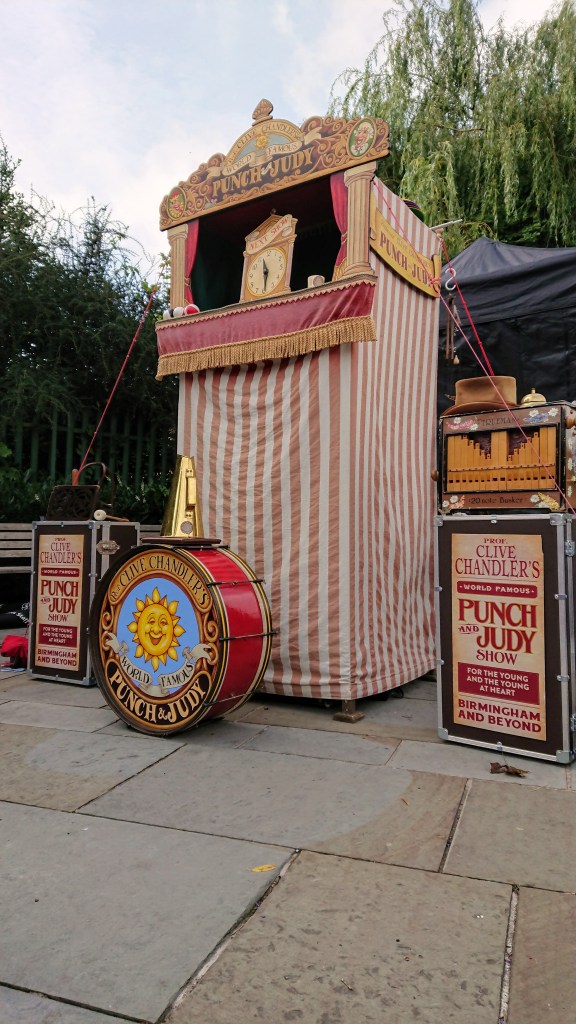
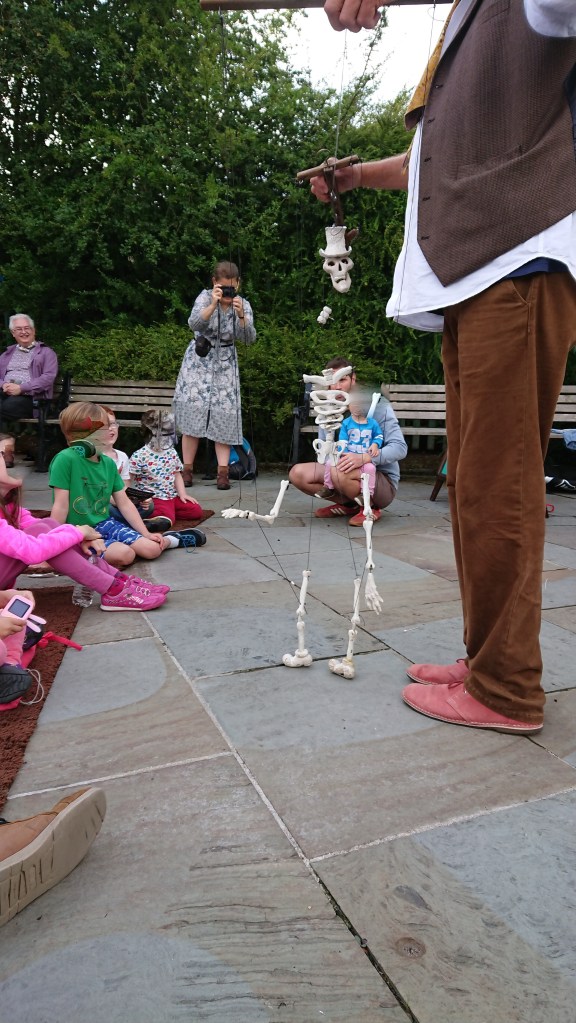
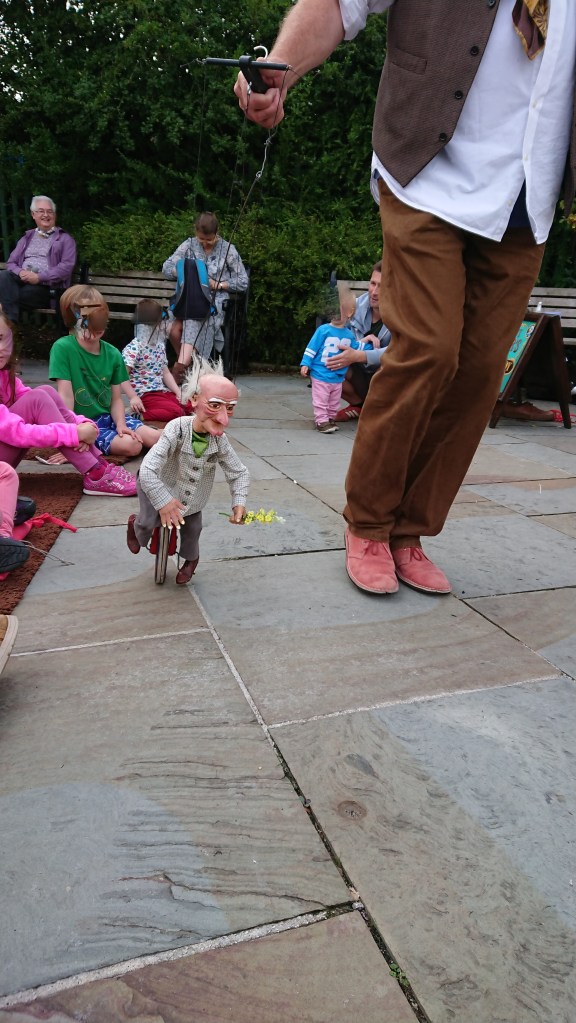
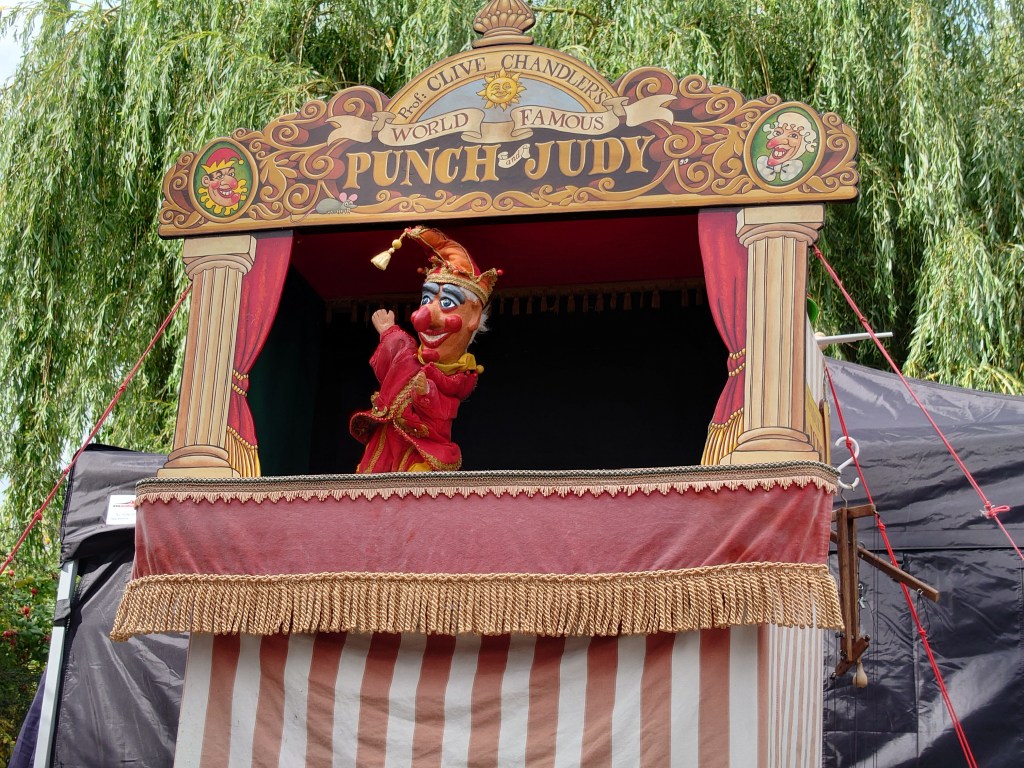
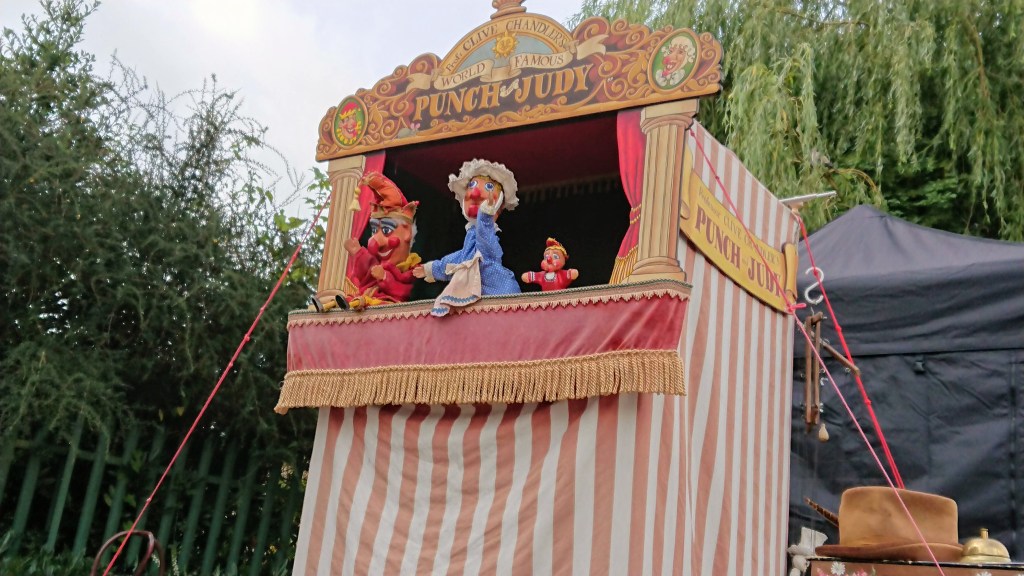
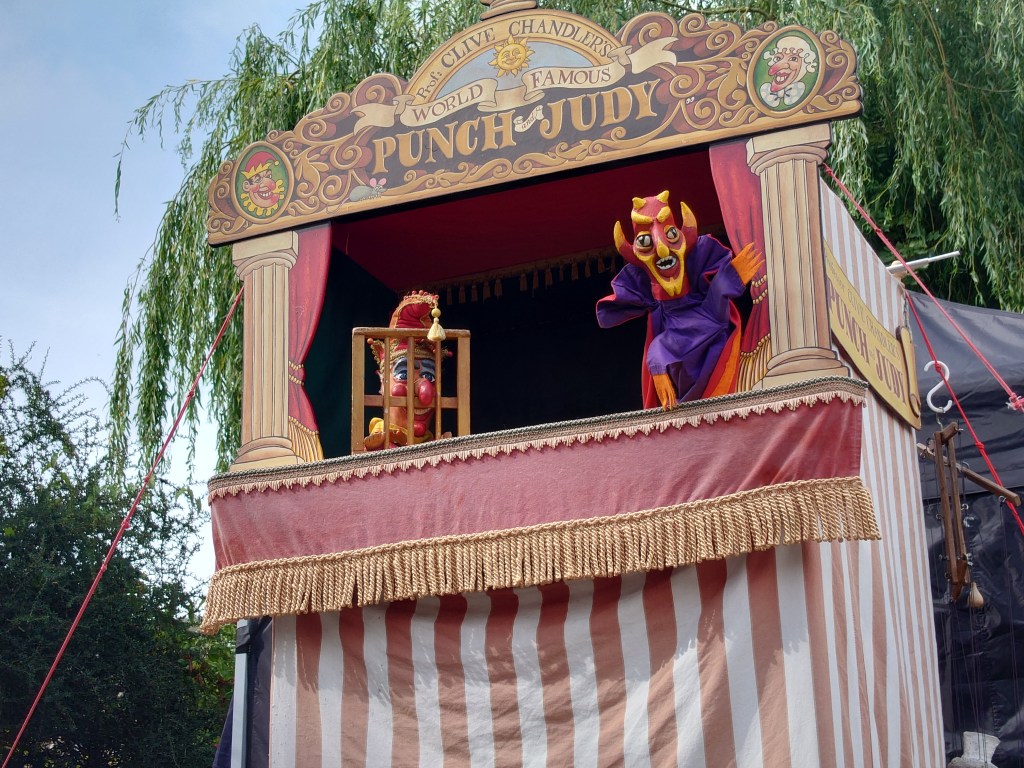
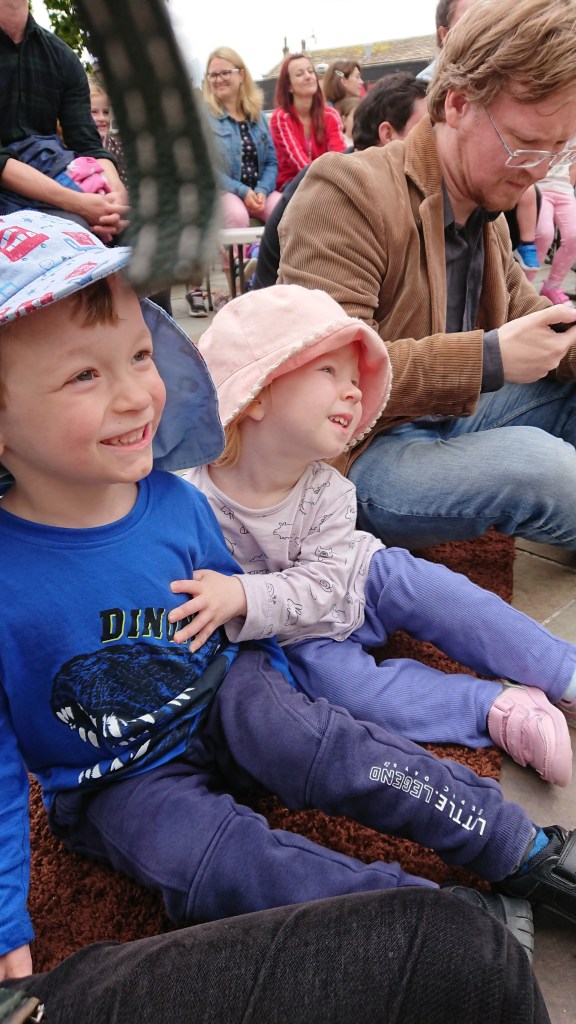
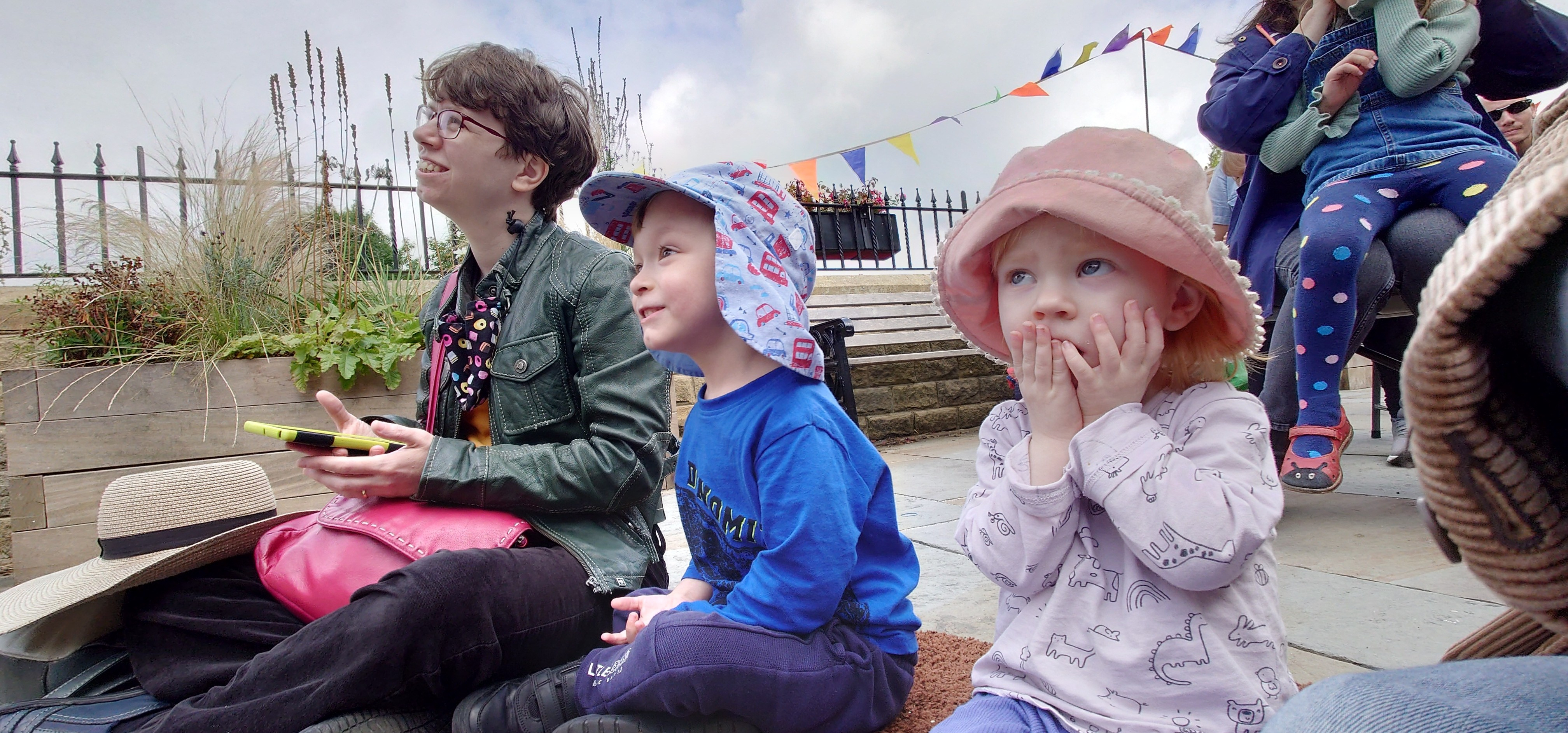
Since going to Upfront for Jack and the Beanstalk; I also took them to Skipton Puppetry Festival as well. Miranda and Anthony were both very taken with the Punch & Judy show by Clive Chandler. They kept talking about Mr. Punch and asking where he is and what was he doing? I decided to get them a set of soft children’s Punch & Judy puppets which they have been having great fun with ever since. They have Punch, Judy, a Policeman and a Crocodile in the set and they have not fought over them, as I feared they might, but have played very nicely with them and they get up to all sorts of things. Sadly, the crocodile does not have a mouth that opens and the sausages are attached to Mr. Punch’s hand but they manage to do a lot with them despite the physical limitations, (imagination is a wonderful thing).
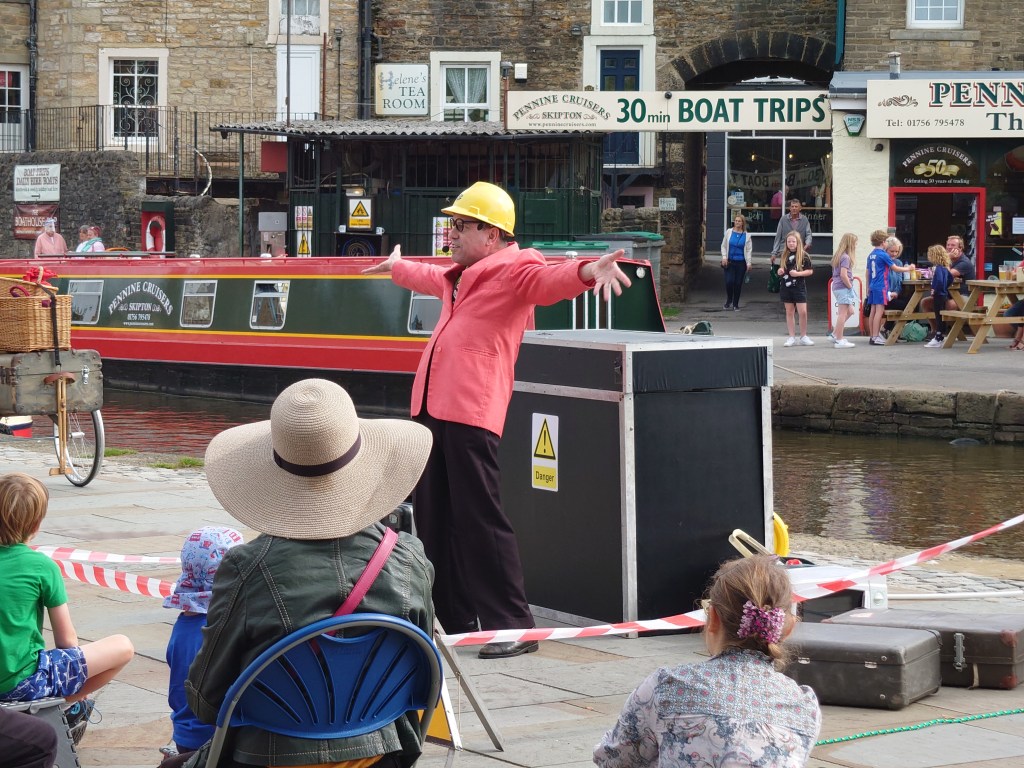
Clive keeps the crowd entertained before the start of the main show…
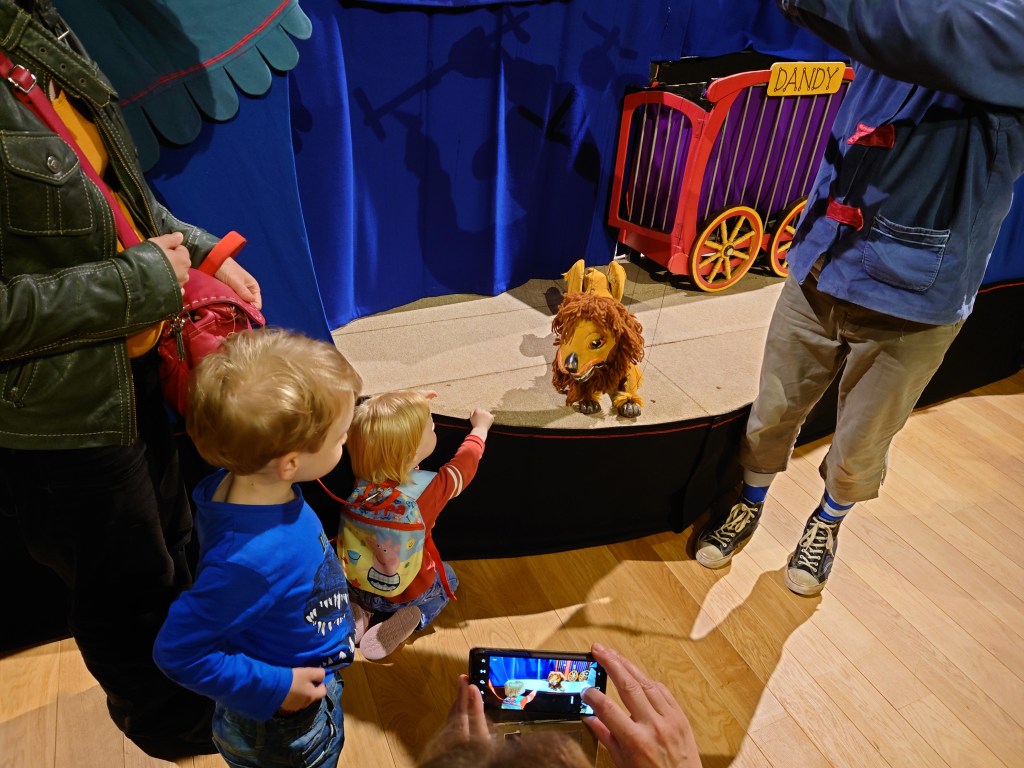
They also saw Noisy Oyster again performing their shows “Dangerous Dave”(which Anthony did find a bit traumatic) and the “Da Silva Circus” which was, (of course) excellent and we were very kindly given a behind the scenes tour by Nik Palmer and Sarah Rowland-Barker. They remembered me from my performance at Beverley Puppet Festival (which was lovely considering that’s quite a few years back now). It was also lovely to see Liz Lempen (and her equally talented sister) again though as we were all masked up at the time we didn’t see quite as much of each other as usual!
There is more puppetry at Skipton this weekend so do check it out: “A November Day” by Thingumajig Theatre at 8pm and “Woodland Tales with Grandad” by Pickled Image at 11am and 2pm.
I recently attended an online sustainability symposium hosted by Wild Rumpus which was looking at all the things that we are, could and should be doing to make our work as outdoor artists more sustainable.
At the beginning of the year we made a big step as a household and as a theatre company towards greater sustainability by swapping our vauxhall zafira for a second hand Nissan leaf.
The zafira was a swap from a Vauxhall Combo van without rear passenger seats so that we would have somewhere to put child car seats following the birth of our first child in 2017. It was a good choice for a compromise between personal and business use as the seats fold down to provide a very large amount of space for carting puppets/sets /workshop materials etc.
Then came the announcement about all new cars being electric from 2035, (more recently they are considering bringing this forward to 2030). In addition to this my car had turned 5 years old and I had just had to get it seen to for its first major repair job (while in my ownership). I felt like the longer I kept it the less it would be worth and the more repairs it would be likely to need.
Tim (my co-performer in RMT and husband) had already started using an electric vehicle (a Renault Zoe) as a second car for our household. So, I felt relatively comfortable with the idea of switching to an electric vehicle of my own as I had already had experience of driving his.
One of the main differences is that it has no gears so those people who have driven automatic cars would find the swap to an electric vehicle quite an easy one.
I decided to get a second hand vehicle as I would be able to buy this using a hire purchase arrangement and at the end of 5 years I will own it outright and have something to show for my investment. At the time, Tim had a PCP on his Zoe and has now switched to a new lease (and a newer Zoe) without the option to buy. I wanted a car at the end of my payments.
So I got a Nissan Leaf which, while nothing like as big as the Zafira, has a fairly roomy boot and the ability to fold the rear seats flat for extra storage space. It is bigger than the Zoe but has a smaller battery (30 kwh) which gives a range of 120 miles with a fully charged battery in ideal conditions (it does not perform as well in the cold).
Before lock down we had the delightful plan of visiting the Covent Garden May Fayre and Puppet Festival for the first time in my new car. This happens every year and commemorates the first documented sighting of Mr. Punch by Samuel Pepys in his famous diary (so it is the official birthday of Mr. Punch).
We were going to take the children too and make it a sort of bus man’s holiday and stay overnight the night before. We had not been previously as the travel costs for us from North Yorkshire to London for an unpaid gig are very expensive but with an electric car we felt the trip would be within our means. We also felt it was worth trying as an experiment to see how practical it would be to use the car to transport the shadow puppet suitcase show to London in this car.
It was going to take a long time to get there compared with a vehicle with a bigger range (hence the need for an overnight stay) but it was going to be an epic electric car adventure.
Then lock down happened, the live event was cancelled and the May Fayre moved online instead.
So the only business journey I actually have done in the new car was to ‘For The Love of It‘ a street arts networking event in Manchester which happened immediately before lock down. The car performed well. The inbuilt sat nav got me to the venue (Cobden Street Works the new base of Walk the Plank) which I had never visited before without a hitch. I navigated to a nearby Instavolt charger at a garage and put on enough charge to enable me to complete the return journey and that was that.
One major change I have had to take on is the use of a smartphone which I inherited from my husband when he upgraded his. A lot of electric chargers require the use of a mobile app for that particular network (and there are lots of different charging networks). Instavolt, however, is one of the networks that allow you to charge using a contactless debit / credit card and the charger had lots of simple easy to read buttons that light up in order to tell you what to do.
I have since discovered that I was fortunate in my choice of first charger experience as Instavolt are very reliable and easy to use compared to some other networks. Some charging points can be broken when you turn up or the charging point works but the app doesn’t.
Another problem for some electric charging points is that they can be ‘Iced’ (the parking space is taken up by an internal combustion engine vehicle) which stops electric vehicles from using them.
The solution to a lot of these problems is Zap Map. This is an app which let’s you plan your journey. You input the range of your vehicle, where you want to go and it suggests charging points you might want to use to get there.
You can see if anyone is using the charging points, whether any are broken and users can report issues they have had with the chargers and upload pictures of the charging station so you can see what it looks like and find them more easily. So if you are planning a long journey and can see a particular charging point is having technical problems over and over again then you can simply choose a different charging point for your route. I think it eliminates what they call ‘range anxiety’ pretty much altogether. If you have plenty of money that is not such an issue any more anyway as most new electric cars have enough range to complete most journeys without the need to charge away from home (in the UK anyway as nowhere is very far away from anywhere else compared to America for example).
We are going to have a different epic electric car journey soon as we are going to Cornwall for 2 weeks. We are planning to use the Zoe as it has the greater range (particularly as we are now in Winter) and we need to get to YHA Eden project (where we are staying) by 10pm at the latest. This gives the different challenge of fitting everything for the holiday into the smaller bootspace This will include clothes for a 3 and a half year old and a 19 month old plus everything else they need and stuff for me and Tim.
So I shall also be taking a holiday from blog writing for 2 weeks so there will be more on the progress of our Secret Keeper Shadow Puppet Murder Mystery Series then. Till then Very Best Wishes and stay safe to you all my lovely readers.








 Puppet Lady